


I started reading at a very early age. By the time I began elementary school I was already reading children’s books. I was the only kid in kindergarten that was allowed to visit our school’s library and check out books.
I once had a librarian jokingly ask me if I had ever made it past the first set of shelves in the library. The 001 section of the Dewey Decimal System contained books that fell under the category “unexplained mysteries.” There were books on UFOs, the Bermuda Triangle and the Loch Ness Monster. I read about crystal skulls and the mummy’s curse and ESP.
And, of course, I read all about Bigfoot. I knew all the legends and stories. Mostly what I knew was the story of Roger Patterson and how he, along with his pal Bob Gimlin, were out searching for Bigfoot in Bluff Creek, California when they literally crossed paths with one. Gimlin grabbed his rifle and Patterson grabbed his 16mm camera and shot approximately 60 seconds of what would become the most famous footage of Bigfoor ever recorded.
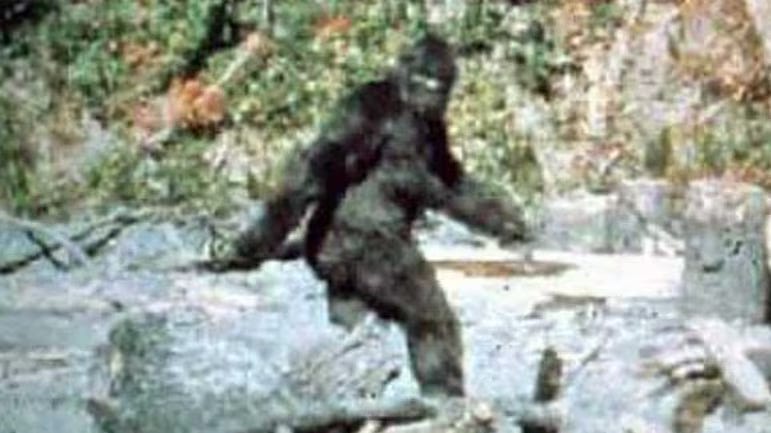
I’m sure you’ve seen the footage. The still above, known as “Frame 352”, is perhaps the best known still image from the footage shot that day. It appears to show a female Bigfoot casually walking through a dry creek, taking a moment to turn her head and stare directly at Patterson. Patterson’s footage became the Bigfoot footage, and this frame became the model for millions of coffee mugs, bumper stickers, and t-shirts.
The Patterson-Gimlin footage has been studied, analyzed, and scrutinized more than any other piece of film except perhaps the Zapruder film. Many professionals from multiple fields have pointed out details that prove the footage’s authenticity. Just a few of the pieces of evidence often claimed is that the creature’s gait is too long to be human, the arms are too long and out of proportion to be human, the creature’s skull slopes back (like an ape) instead of going up (like a human), and that the creature appears to have breasts (who would add that detail?). Many, many special effects artists have said the technology to create such a suit in 1967 simply did not exist, and if anyone could have made such a suit it wouldn’t have been a couple of cowboys like Roger Patterson or Bob Gimlin. Another common observation is that you can see the creatures muscles moving underneath its hair, smething that would be impossible to recreate.
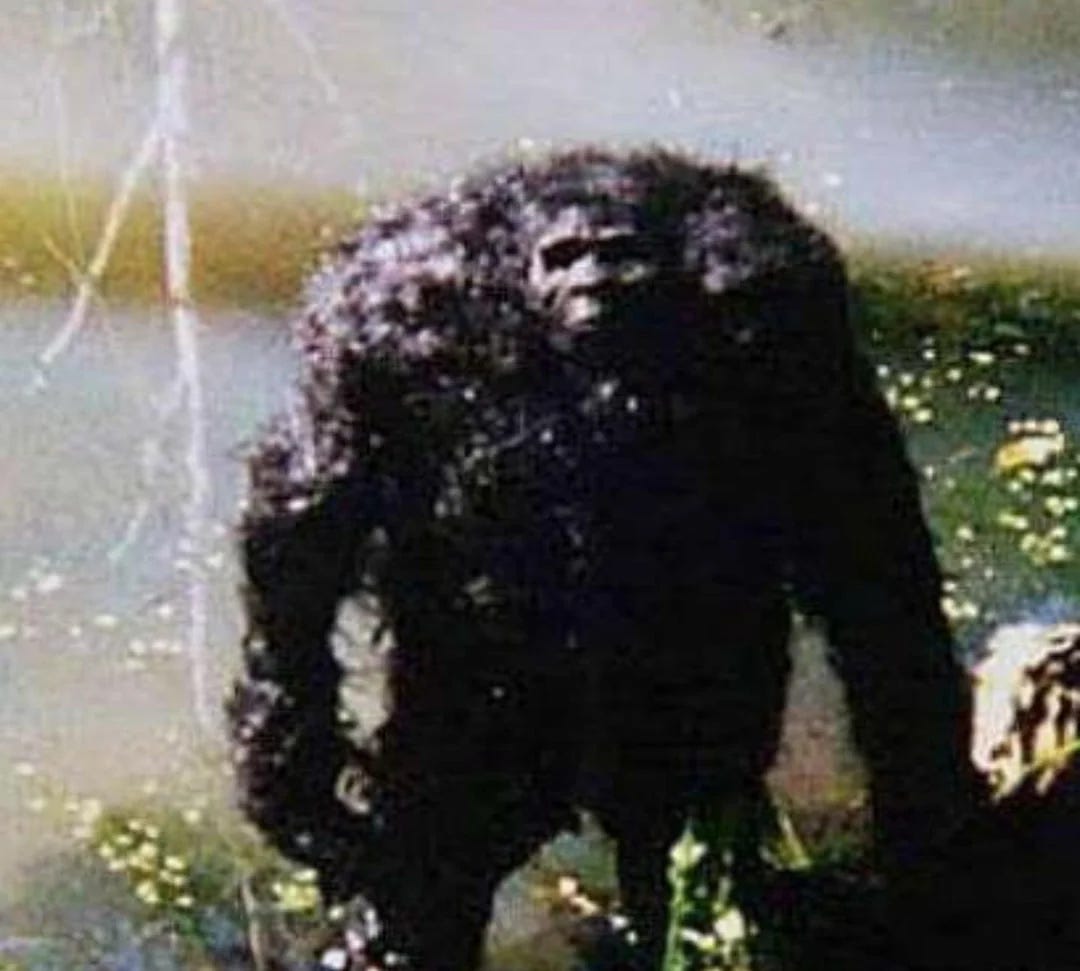
The Patterson-Gimlin footage is not the only time Bigfoot has been captured on film, but nearly every single one of them have been disproven. The photo above was shared with the Bigfoot community in 1995 by a Bigfoot researcher named (and I’m not kidding) Cliff Crook. Crook claimed to have purchased this and other photos from an anonymous forest service ranger in Washington. People in the Bigfoot community actually argued whether or not the photo showed a real Bigfoot, despite the fact that, uh, it’s obviously a small model.
The desire to believe is very powerful.
Capturing Bigfoot is a new documentary that was released today, October 20, 2026. The date is not a coincidence. The Patterson-Gimlin footage was filmed 59 years ago on October 20, 1967. The documentary claims to tell the true story behind the Patterson-Gimlin footage. It also claims to have discovered a “smoking gun” in regards to the Patterson-Gimlin film, something that has never been publicly seen before.
The film delivers both.
One of the biggest questions about the footage is if it was a hoax, who was in on it? Some people thing Patterson set up the hoax and Gimlin wasn’t in on it. Others think the opposite is true, that Gimlin set up the hoax and Patterson was not in on it. Some people think both of them collaborated to pull of the hoax. Some people think neither of them were in on it. And there are those who think the footage is genuine.
By the end of the documentary, you will know the answer to that question.
Patterson passed away in the early 70s, but everyone else connected to the footage is still alive. Patterson went to the grave swearing the footage was real. Gimlin used to say it was a hoax but now says it was real. Patterson’s wife says it was real and his son, Clint, says it was a hoax. Eventually, the old adage “follow the money” pays off and it becomes clear that everyone who made or is making money off the footage maintains it’s real while those who got screwed out of their money claim it’s a hoax.
Like I said, throughout the documentary the truth is slowly revealed, but the real “gotcha” moment is when the smoking gun is revealed. What that smoking gun is has already been running rampant across the internet so I won’t spoil it here, only to say that once you see it… the jig is up.
Or is it?
An anthropologist who has spent decades studying and collecting Bigfoot memorabilia is shown the footage and you can see the exact moment it all clicks. This is the same anthropologist who, at the beginning of the documentary, claims he can name every muscle group moving underneath the creature’s hair in the Patterson-Gimlin footage. The smoking gun is then shown to a man who has spent the past five decades searching for Bigfoot because of this footage. With the wall behind him covered in Bigfoot posters and signs, the man watches the newly found footage and begins to slowly shake his head.
There’s a part of this that feels a bit like walking into an elementary school and telling kids Santa isn’t real — and we, as the audience, get to see those moments. It’s sad to see people who have dedicated their lives to something have the rug pulled out from underneath them while on camera.
But the film is more than just a hit piece. Multiple people associated with the Patterson-Gimlin footage say they wish it had never been released. The footage ruined friendships and wrecked families. It will surprise you to learn who made millions off the footage and who never saw a dime. Because of the film, Patterson’s widow disowned her son, Clint, who is featured prominently throughout the documentary. Gimlin and another men possibly related to the footage, Bob Heironimus, haven’t spoken in decades despite the fact that they live on the same street.
In my opinion, Capturing Bigfoot is a 10/10 documentary — a must see. It’s the bookend on a mystery that began 59 years ago in Bluff Creek, California.
At the beginning of the film’s trailer, Cliff Patterson is seen watching the smoking gun footage and uttering “this is gonna change everything.”
And it has. This morning, Bigfoot researchers across the globe are already poking holes in the documentary. The smoking gun footage is fake, they claim. “The man supposedly revealing a hoax has been hoaxed himself!” one tweet read.
There’s a scene near th eend of Robocop where Dick Jones, the senior president of OCP, is ranting about the company bypassing his ED-209 security droid (which spectacularly murdered an boardroom executive in a previous scene). During his rant he screams that he had military sales, contracts, and part supplies lined up for the next twenty years. “Who cares if it worked!” he shouts.
Replace those shouts with the gutteral howls of a Bigfoot, deep in the woods and hiding in the shadows. Tomorrow there will still be Bigfoot t-shirts for sale. There will still be Bigfoot festivals and reality shows where people go searching for Bigfoot. People will still report sightings and tell stories around the campfire.
Some people will continue to dream about Bigfoot and some people will continue to make money off him, but in the end… who cares if he’s real?