


In case you missed it — and let’s face it, there’s a pretty good chance you missed it — last week the world record for the fastest single solve of a Rubik’s Cube in a competitive setting was broken.
Here’s a funny thought — we now have two very specific bookends for possible “solve times” when it comes to a Rubik’s Cube. On one end, we have the new world record — and I promise you, we’ll be talking about that shortly — and the other bookmark is set at “never.” Like many Gen-Xers, I got my first Rubik’s Cube back in 1982 and excluding sticker-swapping or disassembling the thing, I have never solved one. If someone started a stopwatch the day I received my cube, it currently reads “44 years and counting…”
Have you heard of “cubing” before? Did you know there are cubing tournaments that follow guidelines established by the World Cube Association (WCA)? If you think I’m kidding, I’m not. Cubing is serious business.
So when they said that the world record was broken during a “competitive setting,” here is what that means. At officially sanctioned WCA events, mixing sequences are randomly generated and applied to Rubik’s Cubes away from competitors. These 25-movie sequences are applied twice to ensure the cubes are good and scrambled. Then they are covered so no one can see them and delivered to a competitor. The cover is lifted and the contestant has 15 seconds to look at (but not touch) the cube and plan their attack. Once the cube is picked up a timer starts and when the cube is slammed down on the same mat, the timer stops.
The new world record is 2.78 seconds.
Also, it was set by a nine-year-old kid from Poland.
Before you watch that video, I’d like you to watch this one. This is my son, Mason, at an official WCA competition. He was able to solve a cube in 28 seconds.
For a while my son was into Nerf guns and then one day he wasn’t and was into “cubing” instead. Slowly the Nerf guns disappeared and were replaced with all kinds of cubes. First there were normal ones, and then there were “speed cubes” — special cubes made to spin more quickly. He had cubes of different sizes and different brands and believe me, there wasn’t a single trip in the car where we didn’t hear “clicky-clackity” from the rear seat for about a year. He taught himself how to solve Rubik’s Cubes by watching tutorials on YouTube. The first time took a long time and then he got faster, and faster.
Our interests crossed when he asked me to register a domain for him and set up a WordPress site, where he posted YouTube videos of himself solving different cubes. He designed his own logo and had it printed on a couple of shirts.
All of it kind culminated in that video. Before long something else caught his attention and that was that. The cubes went into a box and the domain expired.
Anyway I wanted you to watch that video because, in theory, this nine-year-old could solve 10 cubes in the amount of time it took my son to solve one in 28 seconds.
Here’s the video. Don’t blink.
This video has a much clearer version of the clip within the first 10 seconds.
This story blew up for a bunch of reasons, one of which is because Teodor Zajderbreak is not Chinese. I guess all the fastest cubers in the world right now are Chinese, but none of them have been able to break the three-second barrier. So the fact that a nine-year-old kid from Poland was the first one to do it is pretty remarkable.
There’s also a lot of talk about the scramble, all of which I’ve read so you don’t have to. The gist of it all is that the kid used an ingenious move to circumvent something or other that added half a second to everyone else’s time. The result is what you saw above.
Enough about that. Let’s talk about the 1982 World’s Fair.
When I was eight-years-old my family drove from OKlahoma to Knoxville, Tennessee to attend the World’s Fair. I don’t think I understood what a big deal a World’s Fair was. I was way more excited that, on our way to the fair, we stayed in Pigeon Forge and I got to go to Magic World, a super weird theme part where we rode rides, saw a magician perform, and I got my picture taken with Jaws.
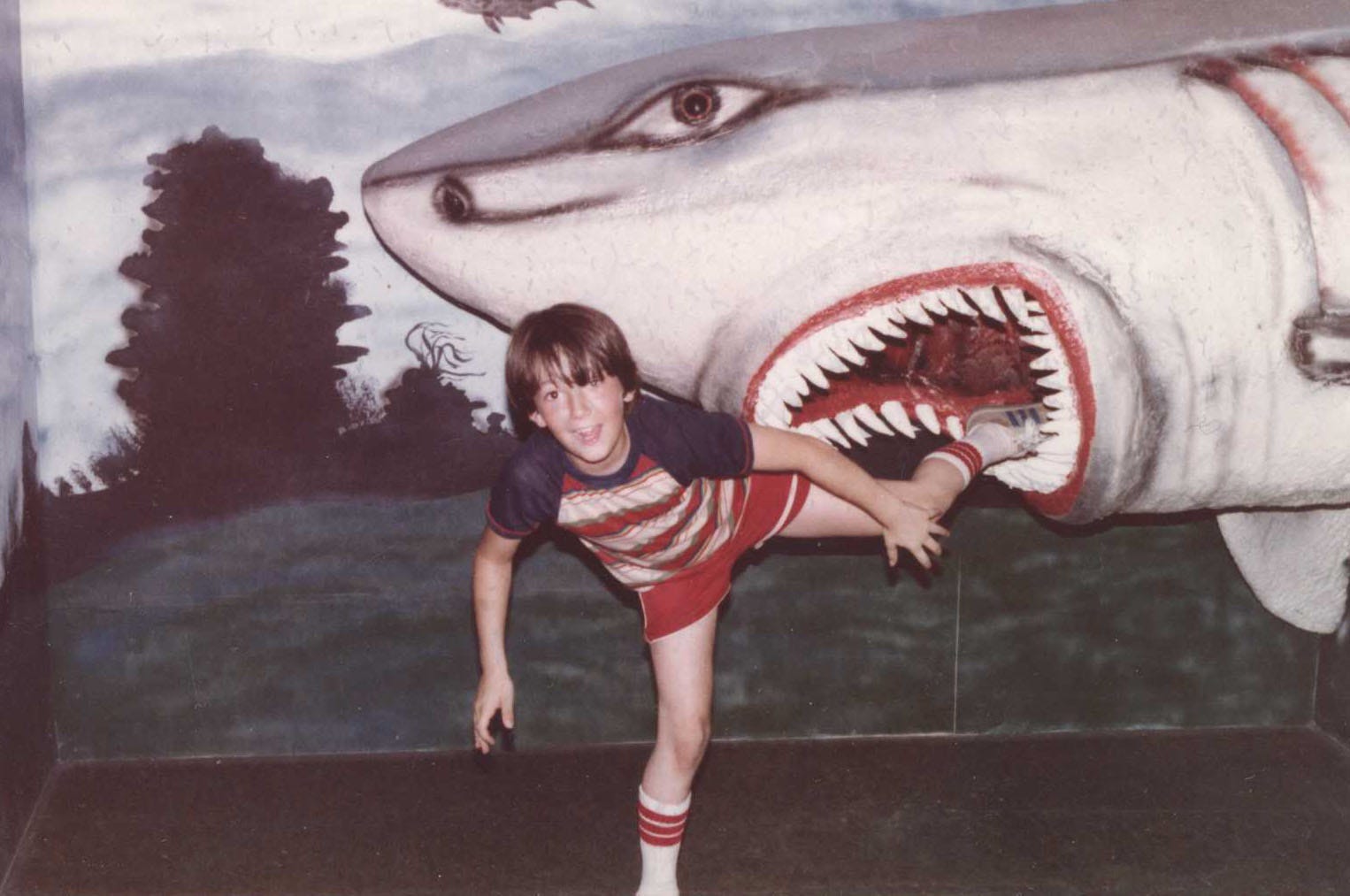
We attended the fair several days in a row and I barely remember any of it. Like, I remember we went to the German pavilion and who the hell cares about that when you’re eight? All I remember was that my feet hurt from walking so much. And then eventually we ended up in the Hungary exhibit. And guess who was from Hungary?
Yeah. Erno Rubik.
And it was there I got to see the world’s largest Rubik’s Cube.
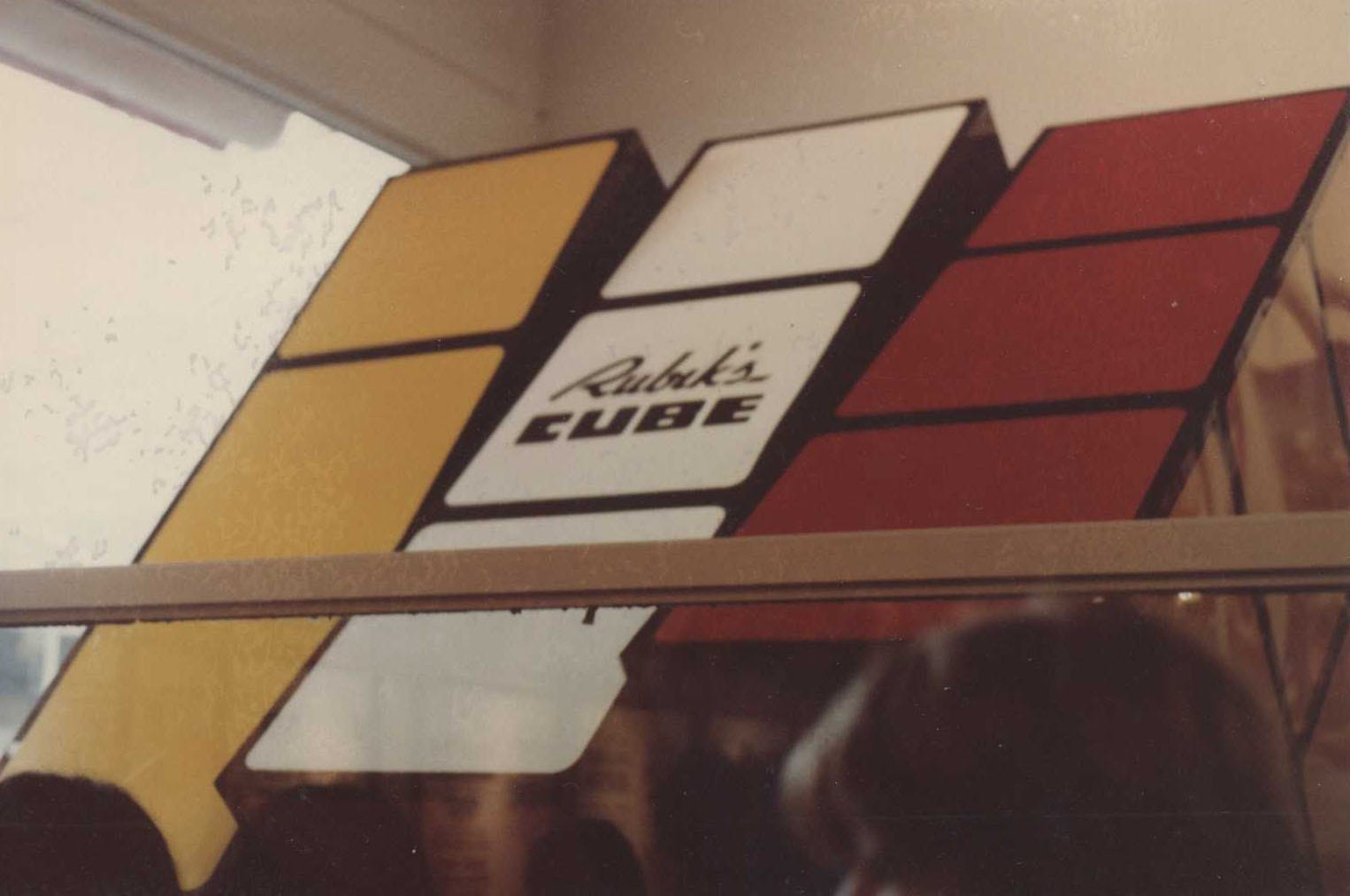
While I couldn’t tell you much about the fair, I sure as hell remember this thing. Not only was the entire cube spinning around in a circle but the two sides were rotating too. It was an honest to goodness working Rubik’s Cube!
As a friendly gesture, Hungary donated the Rubik’s Cube to Knoxville, which was probably less about making friends with Tennessee and more about not having to ship a 10’ tall, 1,200lb cube back to Hungary. I’ve heard different versions of the story but apparently for many years the cube was put into storage and fell into disarray.
For what it’s worth, sometimes being a parent is like solving a Rubik’s Cube. Some people nail it in 2.78 seconds, some people never get it, and a lot of people are just swapping stickers and doing our best.
When you’re a kid you don’t always realize that some of the things your parents do or buy or share is because they love ya. My dad was the first person to sit me down in front of a computer, and all my early musical interests were just his musical interests. Looking back I doubt he was all that interested in seeing a 10’ tall Rubik’s Cube, but he knew I would think it was cool and so we went to see it.
Which is why, nearly 35 years later, I took my kid who was into cubing to see it.

When we saw it, the cube was located in the lobby of a Holiday Inn in Knoxville, although I hear it’s since been moved back to the convention center. It no longer spins or moves, but none of that mattered to my kid who loved seeing it.
I’m proud of my son. My dad is proud of me. Somewhere in Poland, some dad is proud of his nine-year-old kid. +
Amazing skill! A few years ago I practiced really hard to get below 60 seconds. I did it, but I don't think I could have with any pressure one.
Wish they would get some power flowing back into that cube. I was thrilled to see it when I passed through, but was a little sad that it was inert.
In 2010ish, I managed ~1 minute 25 seconds. It was in a hallway at college, not a speed-cubing event. Still enjoy Rubik's cube stories like this. :D